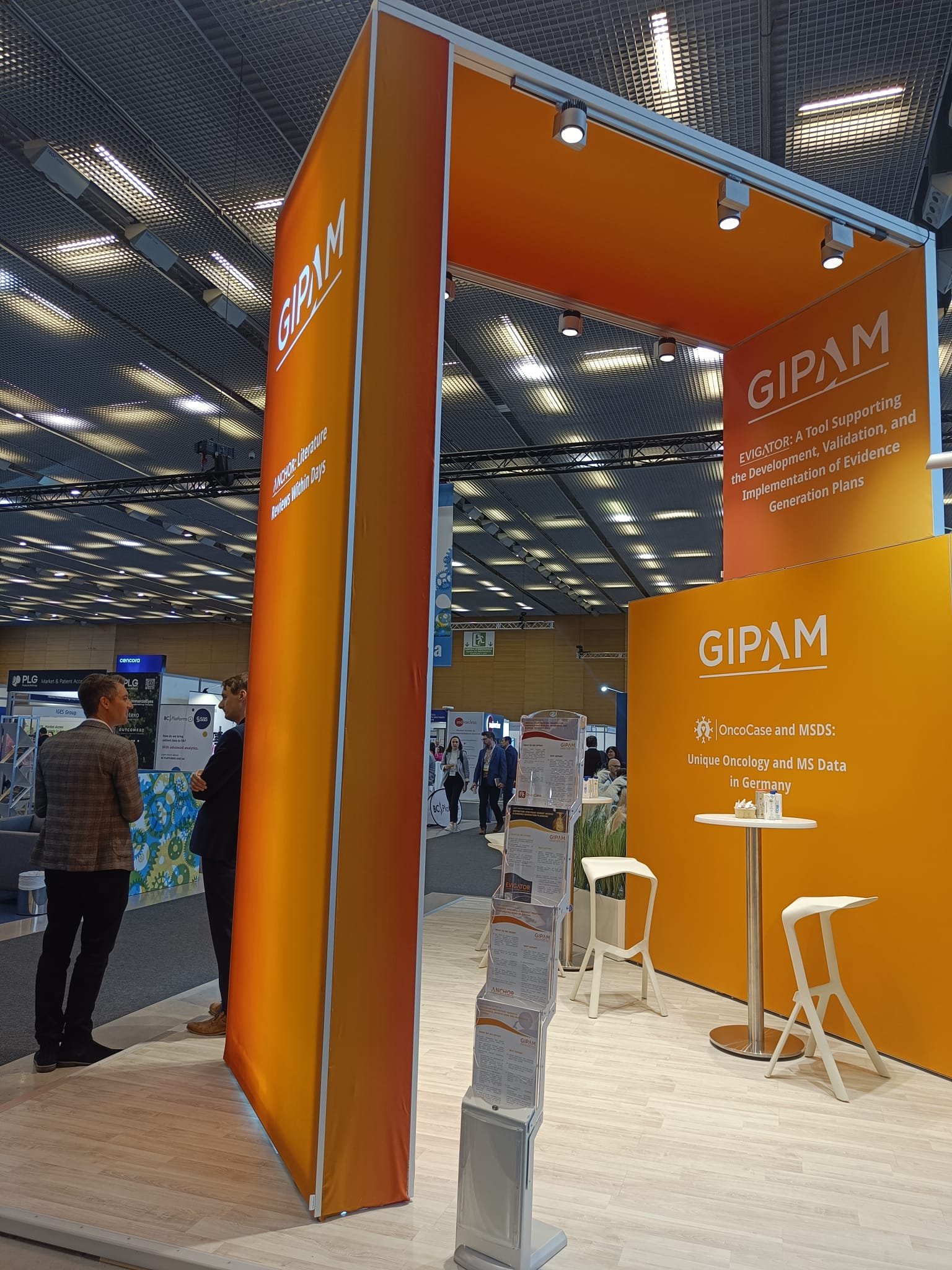
Highlights from ISPOR Europe 2024
Experience the best moments of ISPOR 2024. From impactful discussions to showcasing our innovative solutions like EVIGATOR, ANCHOR and OncoCase, see how GIPAM is shaping the future of market access and real-world evidence.

News & Webinars
How should feasibility assessments for indirect treatment comparisons evolve in the era of EU JCA? Our expanded framework builds on Cope et al. (2014) and adds five new domains.
In incident metastatic bladder cancer in Germany, costs per patient rose from €32,245 to €43,042 between 2011 and 2024, without any improvement in 12-month survival.
In incident metastatic breast cancer in Germany, 12-month survival remained broadly stable from 2011 to 2024, while costs rose by 22.9%, driven by outpatient drugs.
In incident metastatic colorectal cancer in Germany, costs rose moderately (+17.2%) between 2011 and 2024 without a consistent improvement in 12-month survival.
Costs for incident metastatic lung cancer in Germany rose by 87.5% between 2011 and 2024, while 12-month survival improved only modestly and inconsistently.
Costs per patient with incident metastatic prostate cancer in Germany more than doubled between 2011 and 2024 – while 12-month survival remained nearly unchanged.
How large is the burden of atherosclerotic cardiovascular disease (ASCVD) and symptomatic heart failure (HF) in Germany today – and how often is inflammation actually tested in routine care?
The ACHILLES claims data analysis, based on GWQ ServicePlus data from approximately 7.8 million individuals (2020–2024), identified 173,327 incident ASCVD and 121,208 incident symptomatic HF patients. In 2023, the age- and sex-adjusted incidence was 779 (ASCVD) and 668 (HF) per 100,000 individuals. Within 24 months, one in three ASCVD patients and almost one in two HF patients had a CV-related hospitalization – yet CRP testing was observed in only about 40% of patients in the first year after diagnosis.